geeky NEWS: Navigating the New Age of Cutting-Edge Technology in AI, Robotics, Space, and the latest tech Gadgets
As a passionate tech blogger and vlogger, I specialize in four exciting areas: AI, robotics, space, and the latest gadgets. Drawing on my extensive experience working at tech giants like Google and Qualcomm, I bring a unique perspective to my coverage. My portfolio combines critical analysis and infectious enthusiasm to keep tech enthusiasts informed and excited about the future of technology innovation.
Seven Years Later, Google's AI Chief Explains Why Products Lead to AGI
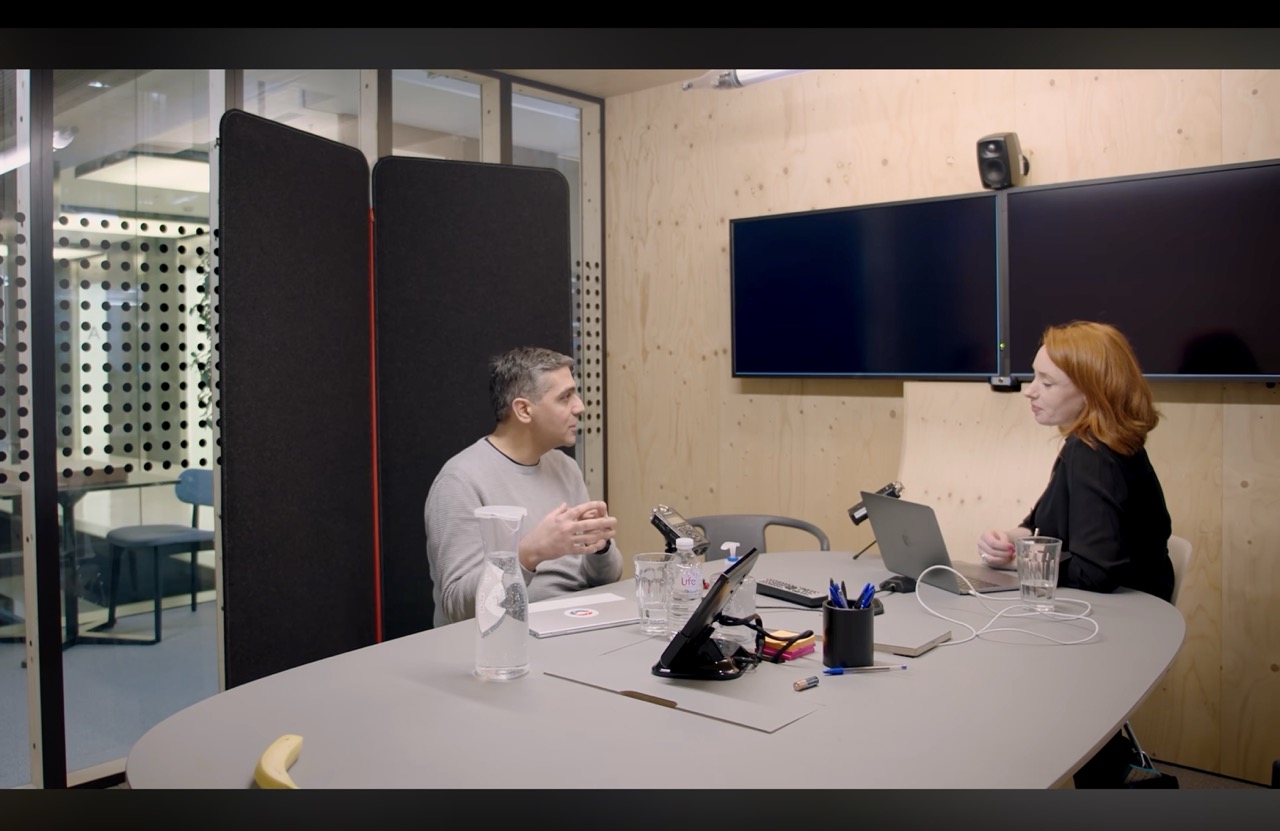
AI Summary
Seven years after a hallway tour of DeepMind's London office, Hannah Fry sat down again with Koray Kavukcuoglu, who now steers Gemini from California. His argument is simple: you can't build general intelligence in a lab and bolt products on later, because products are how you find out what intelligence needs to do. He also gives a measured, unhyped take on recursive self improvement, the idea that AI will help build its own successors.
When Fry reminds him of that 2019 tour, with the AlphaGo team here and the AlphaFold team there, he laughs about how small it all was. "We used to fit on a floor," he says. The teams have merged and grown because of one belief: a single model can generalize across many problems, so everything starts to pull toward it.
That changes how even science projects are framed. Fusion control was once its own RL effort. Now the goal is to train a model that can work in that scientific domain, so one model can take on many problems instead of one.
Why products are the road to AGI
The most interesting part of the conversation is Kavukcuoglu's case that products are not a distraction from AGI. His point is that nobody will ever hand us a test for it. There won't be a benchmark where you pass and someone declares the job done.
What he offers instead is trust. The more you rely on a system to make decisions for you or with you, the more it feels like general intelligence, because handing off decisions requires the ability to handle the real world. Products are the stepping stones. They show where people actually need help, from daily life to work to whole parts of the economy like software engineering.
Fry asks the obvious question: doesn't the grind of making agents book flights and restaurants slow down real research? He says no, and his reasoning is fair. If a model can solve hard problems but can't book a table, that gap is exactly what he means by spikiness. A general intelligence doesn't get to pick which tasks count.
He also says the models are much less spiky than they used to be, though they still are. Closing that gap happens by putting them into real use.
Generality beats narrow wins
There is a recurring idea here that I found clarifying. Machine learning already has a solved recipe for narrow tasks: give a model enough data on one problem and it will learn it. That part, he says, nobody questions anymore.
The harder and more valuable thing is transfer, meaning performance on something the model hasn't seen. Kavukcuoglu says the moments he likes most are when outsiders test a model on a task nobody at Google thought about, and it does well. "We definitely did not optimize for it," he says.
He is careful not to oversell this. He says models transferring to truly unknown territory is still very early. But it is the reason he thinks scaling data and capability is the main route forward.
This scale is also what makes Google's approach harder. Gemini has to work inside products with billions of users. Around the Gemini 3 launch he told Semafor that Google tests heavily, but nothing replaces hundreds of millions of users trying the model. Google released Gemini 3 a year ago in the Gemini app, Search and its developer tools on day one, which is the kind of tight coordination he is describing.
Gemini is a funnel, not a fixed design
A common worry is that Google DeepMind has put too many eggs in the Gemini basket. Kavukcuoglu pushes back by saying Gemini isn't a static architecture. He describes a funnel, with wide experimentation at the top and ideas moving down into the model that ships. Each generation, he says, is something of a custom job, and what is in the pipeline decides how different the next one looks. He expects the architectures of five years from now to look different.
That also frames his response to Yann LeCun, who he worked with at NYU and who thinks LLMs are a dead end. Kavukcuoglu doesn't dismiss him. He says they share the goal of building a model of the world, and that LeCun's research is part of the same exploration. His own bet is that you shouldn't get stuck on what works today.
What the models still miss
Asked whether models have real conceptual understanding, Kavukcuoglu answers with a question: how would you know the difference? His test is predictive power. If a model can handle hypothetical situations it never saw, it has captured something real about the world. Models can now imagine a pink elephant that was never in the data.
But he says they are not there yet on physics. Fluids, airflow, heat transfer and collisions are still weak spots. His line is that models today are visually correct, and he wants them to be numerically correct in the engineering sense. He is confident they will get there, since these are general computing machines that can be trained for it.
On the question of dropping human data, as in the AlphaGo to AlphaZero story, he says yes and no. Models should generate and explore their own data, and in a constrained game that can beat human play. But he wants human data as the anchor, because the goal is a system people can work with and rely on.
Recursive self improvement, without the sci fi
This is the section that will get the most attention. Kavukcuoglu defines recursive self improvement as the full research loop running on its own: exploring data, trying architectures, running experiments, checking results, and training the next model. He says Google is a bit far away from that.
What exists today, he says, are pockets of the pipeline where models can do the work themselves. Gemini is one of the most important tools used to build the next Gemini, and a percentage of compute runs under the control of agents that run experiments. He expects that share to grow, but he is clear that nobody is pressing a button and getting Gemini 13.
There is some outside evidence for the Google side of this story. In an overview of self improving systems, O'Reilly noted that Google's AlphaEvolve cut Gemini's training time by one percent. That is small, but it is an AI making the next AI cheaper to build.
The definitions are slippery, which Kavukcuoglu's careful framing helps with. Labs also define the term differently: some count any AI feedback into model improvement, while others require full autonomy. TechCrunch noted in May that researchers mostly agree recursive systems are not here yet, which matches what he says.
Fry presses him on whether a flywheel is guaranteed. It isn't, and he admits it. Capability could cap out. But he says research is about pursuing things you think are possible, and that an AI making a leap as big as RNNs to Transformers is something he believes can happen eventually, though he hasn't seen it yet.
Safety when the agents work in teams
Fry asks how you keep agents honest when they find clever shortcuts, a problem anyone who has trained RL systems knows well. Kavukcuoglu gives a layered answer.
Build training environments where cheating is not rewarded, so the model never learns it.
Watch training closely for cheating behavior that shows up anyway.
Keep monitoring agents live after deployment, so you can interrupt when one drifts from what the user intended.
The most interesting piece is about chain of thought. Google avoids putting rewards on a model's reasoning so those thoughts stay unfiltered, and then monitors them together with the agent's actions and side effects. He argues thoughts should stay in natural language, partly because it acts as a regularizer and partly because humans can read it. The same approach, he says, extends to teams of agents as long as their communication stays observable and understandable.
He says safety thinking has changed in every way since the days of game playing agents. Once a model can use tools and code, it can act outside its environment, so training and deployment security matter much more. He calls this the shift from the science of researching AGI to the engineering of building it, and says you don't imagine building anything that isn't safe.
Racing, benchmarks and the restaurant test
On slowing down, he says a step that isn't safe shouldn't be taken, and if that means a slowdown, so be it. But he doesn't see a reason to stop based on criteria nobody has defined. He also admits that labs haven't done a great enough job explaining their mitigations to the public, and says competition shouldn't get in the way of doing the right thing.
Who is winning, Fry asks? He treats benchmarks as tools, not scoreboards. They flag gaps and show tasks people care about. When a benchmark saturates, that is what progress looks like, and the hard part is choosing the right tasks next. User feedback matters because things like coding aren't just about correct code. They are about whether an engineer finds the way the model works useful.
The closing exchange is the best. Fry asks what AGI looks like in another seven years. He hopes people will find it normal to have something very intelligent on their phones, and he hopes it can finally book her a restaurant. He calls that the real benchmark.