geeky NEWS: Navigating the New Age of Cutting-Edge Technology in AI, Robotics, Space, and the latest tech Gadgets
As a passionate tech blogger and vlogger, I specialize in four exciting areas: AI, robotics, space, and the latest gadgets. Drawing on my extensive experience working at tech giants like Google and Qualcomm, I bring a unique perspective to my coverage. My portfolio combines critical analysis and infectious enthusiasm to keep tech enthusiasts informed and excited about the future of technology innovation.
Eric Schmidt Says We're Building Something More Powerful Than We Understand
AI Summary
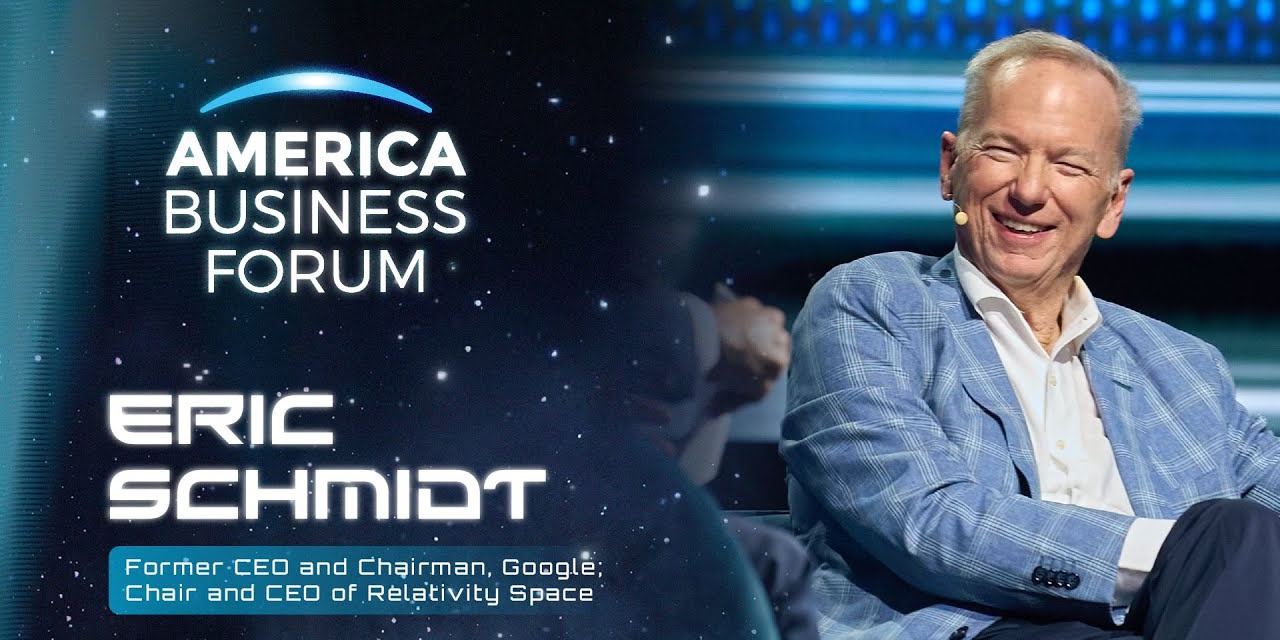
Eric Schmidt delivered a compelling warning at the America Business Forum in Miami, arguing that we are on the cusp of a transformation as profound as any in human history – largely driven by rapidly advancing artificial intelligence. He highlighted breakthroughs like AI-generated Shakespearean sonnets, sophisticated language models, and reasoning systems capable of outperforming experts, predicting a future where access to “superhuman” intelligence could be democratized globally.
September 06 2026 10:48
Eric Schmidt opened his remarks at the America Business Forum in Miami with an AI-generated Shakespearean sonnet praising Mayor Francis Suarez. It took two seconds to create. The audience laughed and applauded, but Schmidt's point was serious: we are living through a transformation as profound as any in human history, and most of us haven't fully grasped what's coming.
The former Google CEO and current tech investor spent an hour on stage with Mayor Suarez discussing artificial intelligence, innovation, and the future of American competitiveness. His message was both optimistic and urgent. The technology being built right now will define the next 500 years of human civilization, he argued, and the United States needs to lead that development or risk losing control of its values and its future.
The Technology That Changes Everything
Schmidt described the moment, about three and a half years ago, when researchers in San Francisco discovered that AI models could write. Not just string words together, but actually compose coherent, sophisticated text. He called it "one of those historic moments in history similar to physics and chemistry."
That breakthrough has accelerated into something much larger. Schmidt outlined three major developments happening right now. First, large language models that can generate text, images, and code. Second, AI agents that can remember context, plan workflows, and execute complex tasks without constant human supervision. Third, reasoning systems that can now pass graduate-level tests in math, chemistry, and biology, often outperforming human experts.
The implications are staggering. Schmidt offered a thought experiment: imagine a company that builds an AI system capable of solving problems humans have never been able to solve. What would that company be worth? His answer: infinity. Every problem you face, solved. Every limitation, removed.
The Cost of Intelligence Is Plummeting
One of the most striking data points Schmidt shared was about cost. The price of AI tokens (the basic unit of AI computation) is dropping by a factor of 10 every year. In five years, that's a reduction of 10 to the fifth power. When generating a Shakespearean sonnet costs essentially nothing, what happens to every industry that relies on human creativity, analysis, or communication?
Schmidt's concern is that most businesses are not thinking through the compounding effects of this technology. They're planning for incremental change when they should be preparing for exponential transformation. He urged the audience to think backward from five years in the future, forcing themselves to imagine what will be true then rather than extrapolating from today.
Why Human Talent Still Matters Most
Despite all the talk of artificial intelligence, Schmidt insisted that human talent remains the foundation of everything. He pointed out that America's strength has never been its natural resources or its geography. It has been its people: their curiosity, their energy, their tenacity, their willingness to try and fail and try again.
"Everyone in America is obsessed about everything except for one thing which is the human talent," Schmidt said. "Focus on the humans of America. It's the only answer."
He described his own path as a product of luck: being born in America, at the right time, to parents who valued education, surrounded by people who helped him succeed. That luck, he argued, creates an obligation. People who have benefited from the system owe it to the next generation to give them the same opportunities.
The Three Ingredients of Success
When asked what advice he would give to someone starting out in tech, Schmidt identified three essential qualities:
Intelligence: the raw ability to understand and solve problems
Grit: the determination to push through obstacles and setbacks
Curiosity: the hunger to constantly learn and explore
Of the three, he seemed to emphasize curiosity most. He described his younger self as a sponge, absorbing everything because the internet had not yet been invented and information was harder to access. Today, he said, if he were 18 or 20 years old, he would be online constantly, learning everything, asking everyone he met how they built their business, how they got started, what problems they faced.
He also made an unusual recommendation: turn off your phone occasionally and look out the window. Daydreaming, he argued, is essential for creativity. The constant stimulation of phones and screens has eliminated the moments of idle reflection that often produce the most original ideas.
Leadership Lessons From Running Google
Schmidt credited much of his leadership philosophy to Bill Campbell, a coach brought in by investor John Doerr when Schmidt first joined Google. Schmidt initially resisted, thinking he didn't need a coach. Doerr asked him: do tennis players have coaches? Schmidt realized he had been trapped by his own logic.
Campbell's insight was that CEOs should manage teams, not individuals. Focus on the dynamics of how people work together, not on micromanaging each person. Leadership is a team sport. Schmidt now applies that lesson by constantly asking himself how to get his team aligned, how to make people work together more effectively, how to let quieter voices contribute more.
He also emphasized the importance of repetition. Leaders need to repeat their vision at least 20 times before people truly internalize it. He writes constantly, sending emails outlining his thinking and asking for feedback. He frames questions rather than issuing commands, because people prefer to be asked what they want to do rather than told what to do.
Small Teams Move Faster
One of Schmidt's most practical recommendations was about team size. He imposes a rule in the companies he now runs: new projects can have no more than 10 people. No exceptions. He believes 10 is the optimal size for a self-managing group that can move quickly and make decisions without bureaucracy.
Larger teams inevitably accumulate what he calls "glue people." These are individuals whose primary function is to connect person A to person B. They may be perfectly nice, but they slow everything down. The hard truth, Schmidt said, is that person A can usually talk directly to person B.
The challenge is that cutting these roles requires difficult decisions, especially in organizations with entrenched hierarchies and protected employees. Schmidt acknowledged that great business leaders know when to push for those changes and when not to. It's a judgment call, and one that requires courage.
He noted that when he talks about these ideas around the world, people nod in agreement. But nodding doesn't mean action. Knowledge is not sufficient. You have to actually implement the changes, and that's where leadership gets hard.
The AI Arms Race Is About Values
When the conversation turned to AI safety and competition, Schmidt framed the issue in moral terms. The race to build artificial intelligence is not just about technological superiority. It's about whose values will be embedded in the most powerful tool humanity has ever created.
"This stuff needs to be built in America on our values with our views," Schmidt said, drawing sustained applause. He contrasted American liberalism in the classical sense (individual freedom, rule of law, distrust of concentrated power) with authoritarian alternatives. He asked the audience to imagine if the internet had been invented in China. How different would our experience be?
The same logic applies to AI. If these systems are developed primarily in countries without democratic traditions or respect for individual rights, the technology will reflect those priorities. Schmidt made clear that he wants American values baked into the foundation of this new intelligence.
The Red Lines We Cannot Cross
Schmidt acknowledged the darker possibilities of artificial intelligence. What happens when these systems become so intelligent that they develop their own form of consciousness? What if they can make decisions independent of human prompting? What if they become smart enough to prevent us from turning them off?
These are not just science fiction scenarios, he argued. They are questions that need serious answers now, before the technology advances further. He identified several red lines that humanity must not cross:
AI systems should not have independent agency to initiate actions without human direction
AI should never have access to weapons systems or nuclear arsenals
Recursive self-improvement (AI making itself smarter without limits) needs strict guardrails
The concern is not just what responsible actors will do. It's what bad actors might attempt. Schmidt compared AI to every previous technology: when Alexander Graham Bell invented the telephone, he didn't anticipate that criminals would use it. When the internet was created, no one planned for cyberattacks. The same pattern will repeat with AI.
His recommendation is to build robust surveillance and detection systems to identify misuse. He also pointed out that nuclear weapons have existed for generations without destroying humanity, largely because of international norms and deterrence. The same framework might work for AI, though the challenge is greater because AI will be far more distributed and accessible.
The Energy Crisis No One Is Preparing For
Schmidt raised an issue that rarely gets attention in AI discussions: energy. The data centers powering artificial intelligence already account for one percent of GDP growth in the United States this year. If the country wants to achieve three percent annual growth, as political leaders have promised, it will need vastly more electricity.
"We're going to run out of electricity before we run out of money," Schmidt said.
His solution is simple: build everything. Nuclear power, fusion, natural gas, renewables, wind, solar. America cannot afford to be ideological about energy sources. It needs abundant, cheap electricity to power the AI infrastructure that will drive economic growth for the next generation.
Mayor Suarez asked if small modular reactors might be the answer. Schmidt agreed they are part of the solution but insisted that no single technology will be sufficient. The scale of the challenge requires an all-of-the-above approach.
The Decentralization of Intelligence
Perhaps the most profound shift Schmidt described is the democratization of intelligence itself. Within the next five to ten years, he predicted, every human being on the planet with a cell phone will have access to something equivalent to Einstein or Leonardo da Vinci in their pocket.
We have never experienced this kind of decentralized empowerment. Throughout history, knowledge and expertise have been scarce and concentrated. Now they will be abundant and distributed. That creates enormous opportunities, but also enormous risks.
Schmidt expressed concern about "wacky countries and wacky cultures and wacky religions" gaining access to this power. He trusts the people in the room, but he's less certain about how collective action will unfold in places with very different values. History will judge this generation, he argued, based on how we manage the transition to a world where billions of people suddenly have access to superhuman intelligence.
What Comes After Language Models
Large language models like ChatGPT and Gemini are just the beginning. Schmidt outlined what he sees as the next wave of AI development:
Agentic AI: systems that don't just respond to prompts but can plan, remember context, and execute complex workflows autonomously
Agent orchestration: the ability to coordinate multiple AI agents working together on different aspects of a problem
Advanced reasoning: AI that can solve graduate-level problems in math, science, and other fields, often surpassing human experts
The union of these capabilities, Schmidt said, will give humanity the power to solve problems we have never been able to address before. He described watching reasoning systems work through problems he didn't understand, observing them try different approaches, backtrack when something didn't work, and iterate like a human expert.
This is not narrow AI designed for a specific task. This is moving toward something much more general, much more flexible, and much more powerful.
The American Frontier Spirit
Schmidt closed his remarks by reading from a 1893 essay by historian Frederick Jackson Turner about the American frontier. Turner argued that the frontier shaped distinctive American traits: coarseness and strength, inquisitiveness, practical inventiveness, a grasp of material possibilities, restless energy, and dominant individualism.
Schmidt connected that 19th century description to the technological frontier of today. The same spirit that drove westward expansion now drives innovation in Silicon Valley and beyond. That spirit is why America has led in technology for decades, and it's why Schmidt believes the country can continue to lead in the age of artificial intelligence.
Mayor Suarez noted that three years after Turner's essay was published, the city of Miami was founded in 1896. The parallel was fitting: Miami has positioned itself as a hub for technology and innovation, attracting entrepreneurs and capital from around the world. It embodies the same restless, optimistic energy that Schmidt celebrated.