geeky NEWS: Navigating the New Age of Cutting-Edge Technology in AI, Robotics, Space, and the latest tech Gadgets
As a passionate tech blogger and vlogger, I specialize in four exciting areas: AI, robotics, space, and the latest gadgets. Drawing on my extensive experience working at tech giants like Google and Qualcomm, I bring a unique perspective to my coverage. My portfolio combines critical analysis and infectious enthusiasm to keep tech enthusiasts informed and excited about the future of technology innovation.
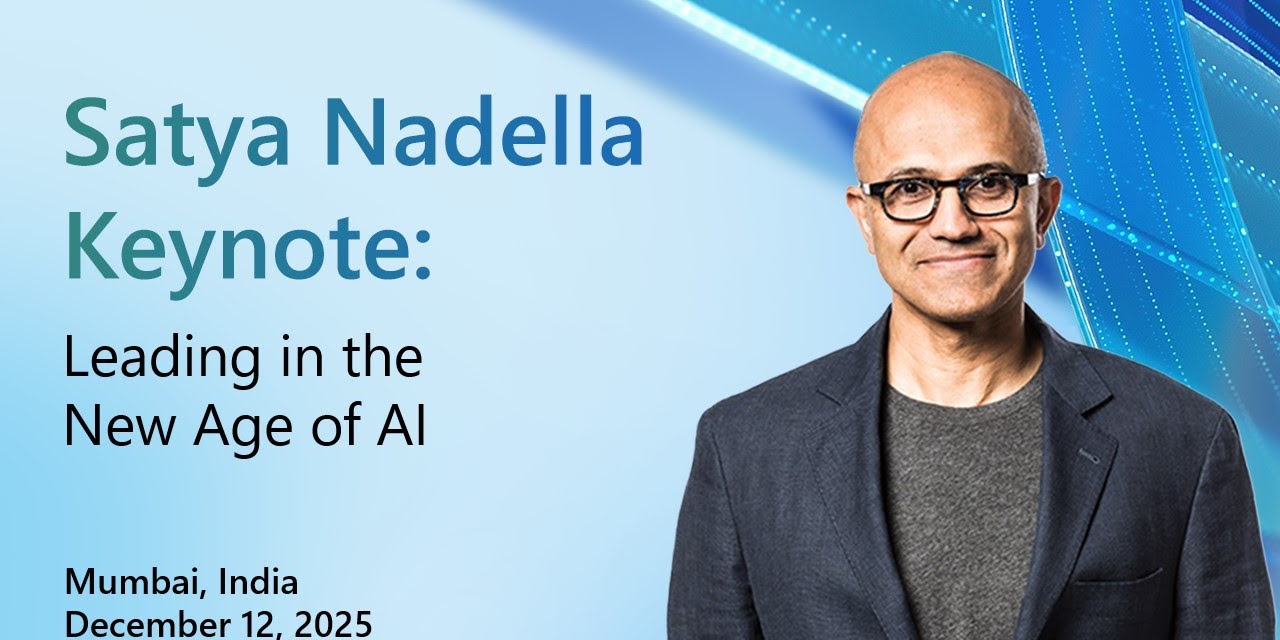
Microsoft's Big Bet on India: Inside Satya Nadella's Vision for AI-Powered Transformation
AI Summary
At the Microsoft AI Tour in Mumbai, CEO Satya Nadella showcased a significant shift in the AI landscape, moving from theoretical potential to a "builder's era" where the barrier to creating sophisticated applications has drastically lowered. By demonstrating a personal cricket research tool built over a weekend, Nadella illustrated a new "test-driven" development philosophy where users utilize "context engineering" and multi-agent frameworks—like the "LLM council"—to solve complex problems through iterative debate rather than rigid specifications.
September 06 2026 10:48
Satya Nadella stood on stage in Mumbai with the kind of energy you don't usually see from a CEO discussing enterprise software. But this wasn't a typical product announcement. Microsoft's leader had just spent his Thanksgiving holiday building an AI application to pick the best Indian cricket test team, and he was about to explain why that personal project represents something much bigger than sports statistics.
The Microsoft AI Tour stop in Mumbai revealed a company at an inflection point, one where the theoretical promise of artificial intelligence is being replaced by concrete tools that people can actually use. More importantly, it showed how India has become central to Microsoft's AI strategy, both as a market and as a proving ground for technology that could reshape how work gets done globally.
The Shift from Thinking to Building
Nadella opened with a premise that challenges how most people think about AI. "When you talk about building an AI solution, you don't start with a spec," he explained. "You start with the test." This represents a fundamental inversion of traditional software development. Instead of writing detailed requirements and building toward them, you define your desired outcome, create evaluation criteria, and then let AI systems iterate toward that goal.
This isn't just philosophy. It changes what skills matter. Nadella described how people are now doing "context engineering," which means figuring out how to feed AI systems the right information rather than writing code line by line. The implication is clear: the barrier to building useful applications just got dramatically lower.
During the keynote, Nadella casually pulled up his personal Azure subscription and GitHub repository to show the deep research tool he'd built over the holiday. The application wasn't remarkable because of its complexity. It was remarkable because a CEO with limited free time could build something genuinely useful in a few days, deploying multiple AI models in what he called different "decision frameworks."
Work IQ: The Hidden Database Powering Everything
One of the most significant announcements wasn't really an announcement at all. Nadella described something called Work IQ, which sounds like typical enterprise jargon until you understand what it actually does. Work IQ is Microsoft's term for the structured database it has built from all the tacit knowledge inside organizations using Microsoft 365.
Think about what that means. Every email you've sent, every Teams meeting you've attended, every document you've edited, and every relationship you have with colleagues is now organized in a way that AI can understand and query. "The tacit knowledge inside any corporation is the knowledge of people, their relationships with other people, their work artifacts," Nadella said. That knowledge, previously locked away in individual inboxes and file shares, is now accessible.
This matters because AI models are becoming commoditized. OpenAI, Anthropic, Google, and others are all producing capable models. What differentiates one AI application from another increasingly comes down to the quality of the context you can give it. Work IQ, combined with similar systems for Excel and PowerBI data (called Fabric IQ) and a new retrieval system (Foundry IQ), represents Microsoft's answer to the context problem.
Agent Mode: Excel Gets Its GPT Moment
Zoe, a product marketer from the Copilot team, demonstrated features that would have seemed like science fiction two years ago. The most striking was Excel's agent mode, which Nadella claimed he's particularly excited about because it does for spreadsheets what GitHub Copilot did for code.
Instead of using formulas to manipulate a spreadsheet, you can now tell an agent what you want to understand about your data, and it will build the formulas, create visualizations, and apply formatting. More importantly, it can iterate. Just as developers can now have AI write code, review it, and improve it in cycles, Excel users can have agents build complex financial models or data analyses through conversation.
Nadella participated in the Excel World Championship (yes, that's real, and yes, ESPN broadcasts it) using this agent mode. His enthusiasm was genuine. "I've worked on Excel all my life, and to see how the agent mode understands deeply the entire semantics of a spreadsheet, it's not just a one-shot model creation but the ability to iterate continuously."
The demonstration showed Zoe updating a monthly business review by simply asking the agent to incorporate November data. The agent searched through emails, meetings, and files to find relevant information and updated the document automatically. For anyone who has spent hours compiling reports from scattered sources, the time savings are obvious. But the bigger shift is conceptual: documents become living things that can update themselves based on current information rather than static artifacts that require manual recreation each month.
Agent HQ: Where Code Meets Conversation
Karan from the GitHub team demonstrated what Microsoft calls Agent HQ, which might be the clearest vision yet of how software development changes in the AI era. The concept is straightforward: you can assign tasks to AI agents from anywhere you work on GitHub, whether that's the website, VS Code, the command line, or even your phone.
Karan showed a toy store application that needed search and filter functionality. Instead of writing code, he described what he wanted, assigned it to an agent, and let it work in the background. He could check on progress in a "mission control" view that showed all active agent sessions. When one was complete, he could review the changes, provide feedback, or ask for modifications.
What makes this different from existing AI coding tools is the integration. Custom agents can be created for specific domains or workflows. Multiple agents can work on different aspects of a project simultaneously. Security scanning and code review happen automatically through additional agents powered by Microsoft Defender.
Perhaps most significantly, developers can now bring their own models into the workflow. Karan showed how he'd connected fine-tuned models deployed on Microsoft Foundry to GitHub Copilot. One model was trained to respond like a developer in Mumbai, explaining Kubernetes concepts in conversational language. The point wasn't the novelty but the flexibility: developers can customize the AI assistance they get by deploying and connecting their own specialized models.
The Decision Framework Approach
When Nadella showed his personal research application, he wasn't just demonstrating technical capability. He was illustrating a new approach to using AI for decision-making that has nothing to do with asking ChatGPT for answers.
His app implemented several frameworks. One was the "LLM council" concept from AI researcher Andrej Karpathy, where multiple AI models act as committee members debating a question, with one serving as chairman to synthesize their responses. Another was DxO, a methodology from healthcare where different roles (lead researcher, critical reviewer, domain expert, data analyst) are assigned to different models, each contributing their perspective.
The really interesting one was the ensemble approach, where queries get sent to multiple models in parallel, responses are anonymized to remove bias, and then synthesized. Nadella had even added a "debate" mode with formats like pros/cons, SWAT analysis, risk vs. impact, and counterfactual thinking.
He used all of this to select an all-time Indian test cricket team. The chairman's synthesis from the LLM council showed which players had unanimous support (Gavaskar, Dravid, Tendulkar, Kohli, Kapil Dev) and where models disagreed (whether to include VVS Laxman). The critical reviewer in the DxO framework identified biases like "era bias," questioning how to compare players from different generations when equipment and training have evolved so dramatically.
This might seem frivolous until you consider the applications. Healthcare diagnoses, financial risk assessment, supply chain decisions, insurance underwriting—any high-stakes situation where different perspectives and identifying cognitive biases matter could benefit from this multi-agent approach. Nadella noted that in healthcare implementations, the DxO framework outperformed any single model.
MahaCrime OS: AI in Action
The most concrete example of impact came from MahaCrime OS, an investigative tool built for Maharashtra state police in partnership with Marvel (the state's tech initiative), Microsoft, and a company called Cyber Eye. The system serves as an investigation copilot for cyber crime and financial fraud cases.
Given that the state receives about 30 cybercrime reports daily, the scale of the challenge is significant. MahaCrime OS uses pattern detection and AI analysis to guide investigations, reducing turnaround times by 80% according to officials. The video showed investigators describing how the system helped solve a case for a crime victim in Nagpur by quickly identifying patterns and connections that would have taken much longer through manual investigation.
What's notable is the speed of deployment. This isn't a pilot program or a research project. It's a production system processing real cases, built on Azure infrastructure using Microsoft Foundry for AI services, Defender for security, and Fabric for data analysis. The Maharashtra government's Chief Minister sponsored the initiative, and Nadella met with both leadership and the investigative teams using it.
The broader significance is what this represents for AI diffusion. In previous technology waves, cutting-edge applications took years to reach government services in emerging markets. Here, a sophisticated multi-agent system for criminal investigation was deployed in months, built on the same infrastructure and tools available to any developer.
The Infrastructure Reality
Behind all the agent demos and application examples sits a less glamorous but crucial reality: AI requires massive computational infrastructure. Nadella described data centers as "token factories" and reduced the entire challenge to one equation: performance per token equals tokens per dollar (or rupee) per watt.
This efficiency frontier determines how much AI capability a country or company can deploy, which directly correlates to productivity gains and economic growth. It's why Microsoft is investing $17.5 billion in India, the company's largest investment in Asia. This builds on a prior $3 billion commitment and will fund multiple data center regions across the country.
The new South Central region in Hyderabad will be 100% renewable, addressing the environmental concerns around AI's energy consumption. Microsoft is also emphasizing sovereignty, offering everything from public cloud to private cloud options, with local key management and confidential computing that keeps data encrypted even during processing.
The sovereignty discussion extended to security. Nadella made the case that effective cybersecurity requires global intelligence, since Microsoft sees "trillions of signals every day" and monitors nation-state and criminal cyber activity worldwide. The tension between data sovereignty and security intelligence is real: a completely isolated system lacks the threat intelligence to defend itself effectively.
Karan's demonstration included integration between Microsoft Defender for Cloud and GitHub Advanced Security, showing how production vulnerabilities detected at runtime could be automatically fixed by AI agents. This isn't a static security checklist but continuous monitoring and remediation based on current threat intelligence.
What This Means for Developers
GitHub's growth in India tells its own story. By 2030, India is expected to be the number one country for GitHub participation. Nadella noted not just the volume but the increasing ambition of projects coming from Indian developers.
The tools being released fundamentally change what "being a developer" means. When Karan could describe a feature in plain language and have an agent implement it, write tests, and submit a pull request, the bottleneck shifts from coding ability to problem definition and judgment. When Nadella could fine-tune a model over a holiday weekend and integrate it into his workflow, the barrier between "AI researcher" and "application builder" disappeared.
Microsoft is positioning GitHub as "Agent HQ" where developers access multiple coding models, not just one. The Code IQ concept mirrors Work IQ: your repository becomes a structured knowledge base that AI agents can reason about and modify. Whether you interact through an IDE, command line, or chat interface becomes a matter of preference rather than capability.
The plan agent in VS Code that Karan demonstrated represents another conceptual shift. Instead of jumping straight into implementation, you can work with an agent to develop an implementation plan, iterate on it until you're confident, then either code it yourself or hand it to an agent to complete. This preserves human judgment about architecture and approach while offloading the mechanical work of implementation.
The Unlearning Challenge
Nadella kept returning to a theme: "You have to do this hard job of unlearning and learning what's possible." He wasn't talking about learning new programming languages or frameworks. He was talking about mental models.
Starting with test cases instead of specifications. Thinking about context engineering instead of schema design. Building multi-agent systems instead of monolithic applications. Using conversation and iteration instead of upfront planning. These aren't incremental changes to existing practices. They're different approaches that can feel unnatural to people trained in previous paradigms.
The cricket team example illustrated this well. Nadella didn't build a statistical model to rank players. He built a system where multiple AI models debated the question, identified their own biases, challenged each other's assumptions, and synthesized their disagreements. The outcome wasn't just a list of names but an understanding of why the decision was difficult and what trade-offs were being made.
This approach scales. Yes Bank implemented 40+ use cases and saw ROI in each. Aditya Birla simplified complex product interactions through conversational interfaces. LTI Mindtree is doing what they call a "wall-to-wall transformation," rethinking every business process from an AI-first perspective. Mankind Pharma equipped medical representatives with AI assistance to confidently answer doctor questions in rural areas.
India's Opportunity
Nadella's message to the Mumbai audience was clear: India has a unique opportunity in this technology wave. The infrastructure is being built locally. The tools are available immediately, without the lag seen in previous generations. The developer community is large and growing. The ambition level is high.
The GigaTime model he described exemplifies the potential. Developed by Microsoft with the University of Washington and Providence hospitals, it's an open-weight model that simulates complex immune system tests for cancer patients using simple pathology images. This could make personalized immunotherapy accessible in tier 2 cities across India because an entrepreneur can take the model and build a service around it without needing to develop the underlying AI.
"When you're playing the game, sometimes you forget why you're playing it," Nadella said, discussing GigaTime. "This is why we're playing it. We're playing it so that we can use this innovation to make a real difference in the world."
The MahaCrime OS example showed this isn't hypothetical. Real systems are being deployed, processing real cases, delivering real outcomes. The rate of diffusion is faster than anything seen in previous technology cycles. The gap between what's possible in Silicon Valley and what's deployed in Mumbai has essentially disappeared.
The Microsoft Stack, Fully Assembled
Looking at everything demonstrated in Mumbai, Microsoft's AI strategy becomes clear. At the experience layer, Copilot is embedded everywhere people work, now functioning as a "browser for the agentic web" rather than just a chat interface. Below that, the IQ layer (Work IQ, Fabric IQ, Foundry IQ) provides structured context from organizational knowledge, business data, and any other source.
The agent layer includes everything from simple automation through Copilot Studio to complex multi-agent systems built with Microsoft Foundry. GitHub serves as Agent HQ, providing access to multiple coding models and managing agent workflows. Tools like VS Code and Visual Studio provide the development environment.
At the bottom, Azure provides the infrastructure with options ranging from public cloud to sovereign configurations. Security and governance come through Agent 365, which extends identity management, threat protection, and data loss prevention to the agentic world.
This isn't a collection of separate products. It's an integrated stack where each layer builds on the ones below. A developer using GitHub to build an agent can connect to models in Foundry, access organizational context through Work IQ, deploy to Azure with appropriate sovereignty controls, and have security monitoring through Defender, all within a single workflow.
The Really Hard Questions
What wasn't discussed much in Mumbai were the difficult questions this raises. When agent mode in Excel can build complex financial models, what happens to financial analysts? When GitHub agents can implement features from natural language descriptions, what happens to junior developers? When AI researchers can quickly identify patterns in criminal cases, how do we ensure the patterns aren't biased?
Nadella's excitement about these tools is genuine, and the capabilities are impressive. The rate of progress is remarkable. But the social and economic implications of this level of automation arriving this quickly are enormous. The jobs being automated aren't just routine data entry. They're skilled professional work that required years of training.
Microsoft's answer seems to be that these tools augment rather than replace, making people more productive and allowing them to focus on higher-value work. Zoe said "Copilot hasn't just made me better and faster at my job, it's helped me make more impact." That's probably true for knowledge workers at Microsoft. Whether it's true for everyone whose work can now be partially or fully automated is a different question.
Nadella ended where he started: "All of this is about empowering every person and every organization in India to achieve more." Whether that empowerment is distributed broadly or concentrated among those who can adapt fastest is perhaps the defining question of this technology transition. The tools Microsoft demonstrated in Mumbai are powerful. How they get used, and who benefits, is still being written.